Earthquake magnitude is measured using the Richter Scale.

All of the earthquakes that we have here in Spain, are either Minor or Small. This is because, here in Spain, we aren’t directly underneath a joint of two tectonic plates, see my page on tectonic plates .
However in California, the earthquakes are much bigger because it is near the joint of two tectonic plates.
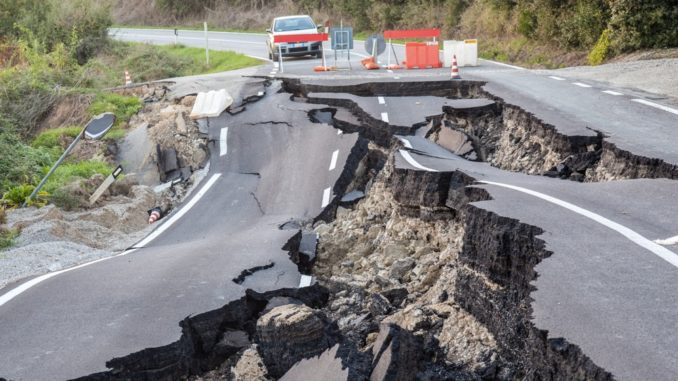
Scientists estimate that 900,000 of such “small” quakes occur every year. Up to 30,000 of quakes measuring 2.5 to 5.4 occur in a year as well, and these cause minor damage and are certainly noticed by people. The higher the number on the Richter scale, the fewer earthquakes occur every year. Quakes registering 8.0 or higher occur, on average, only once every 5 to 10 years.

The scale is not a normal number scale, however; rather, it is a logarithmic scale. This means that an earthquake that measures 2 on the Richter scale is 10 times as powerful as an earthquake that measures 1. In addition, each whole number increase means 32 times more energy is released.
The Richter scale measures earthquakes in whole numbers and tenths numbers. Most earthquakes register 2.5 or less and are too small to be experienced by people. Seismographs register these quakes.
The largest earthquake ever recorded was in Chile in 1960, which measured 9.5 on the Richter scale. The Richter scale is not very accurate in measuring these larger earthquakes and today scientists use the moment magnitude scale which uses the same logarithmic scale but which more accurately measures the strength of larger earthquakes.
 Emily Henderson @ ELIS